
The System Is Beginning to Show Its Hand
March 16th, 2026
Each week we monitor a set of macro indicators across several layers of the financial system. These indicators help us track where stress, liquidity, and capital flows are developing beneath the surface of markets.
Rather than focusing on any single market move, our objective is to observe how the system as a whole is evolving.
Over the past several weeks a number of signals have been forming. This week those signals became clearer. Volatility is settling in, credit conditions are tightening, and liquidity signals are quietly shifting beneath the surface.
Three patterns now stand out:
Volatility is settling in as the baseline market environment
Credit spreads are gradually widening
Liquidity conditions are evolving through fiscal channels
None of these signals alone determines where markets will move next. But taken together, they help illuminate how the system is adapting to uncertainty.
Volatility Is Becoming the Baseline
The story in markets right now is not that volatility has suddenly appeared. It’s that volatility is increasingly becoming the baseline environment. Instead of isolated spikes, markets have now spent several consecutive weeks adjusting to larger daily swings and greater uncertainty around macro conditions.
The interesting detail in the data is where this volatility is coming from.
While equity volatility — captured by the VIX — has been rising, the move has been even more pronounced in the bond market. The MOVE Index, which tracks volatility in U.S. Treasury markets, has surged significantly in recent weeks. Equity volatility typically reflects uncertainty about corporate earnings or economic growth.
Bond market volatility reflects something deeper: uncertainty about the structure of the macro environment itself — inflation, fiscal policy, liquidity conditions, and the future path of interest rates. When volatility begins to embed itself in the bond market, it tends to ripple outward across the financial system.
Put differently:
The volatility we are observing today is not confined to equities — it appears to be increasingly anchored in the bond market as well. That dynamic often produces a more persistent volatility regime than a typical equity correction.
Credit Is Quietly Tightening
If volatility is usually the first signal that risk appetite is changing, credit markets are often where that shift begins to show more clearly. The metric we are watching most closely here is the spread between high-yield and investment-grade corporate bonds.
This spread represents the additional yield investors demand to lend to lower-quality borrowers rather than stronger ones. Over the past several weeks that spread has been gradually widening.
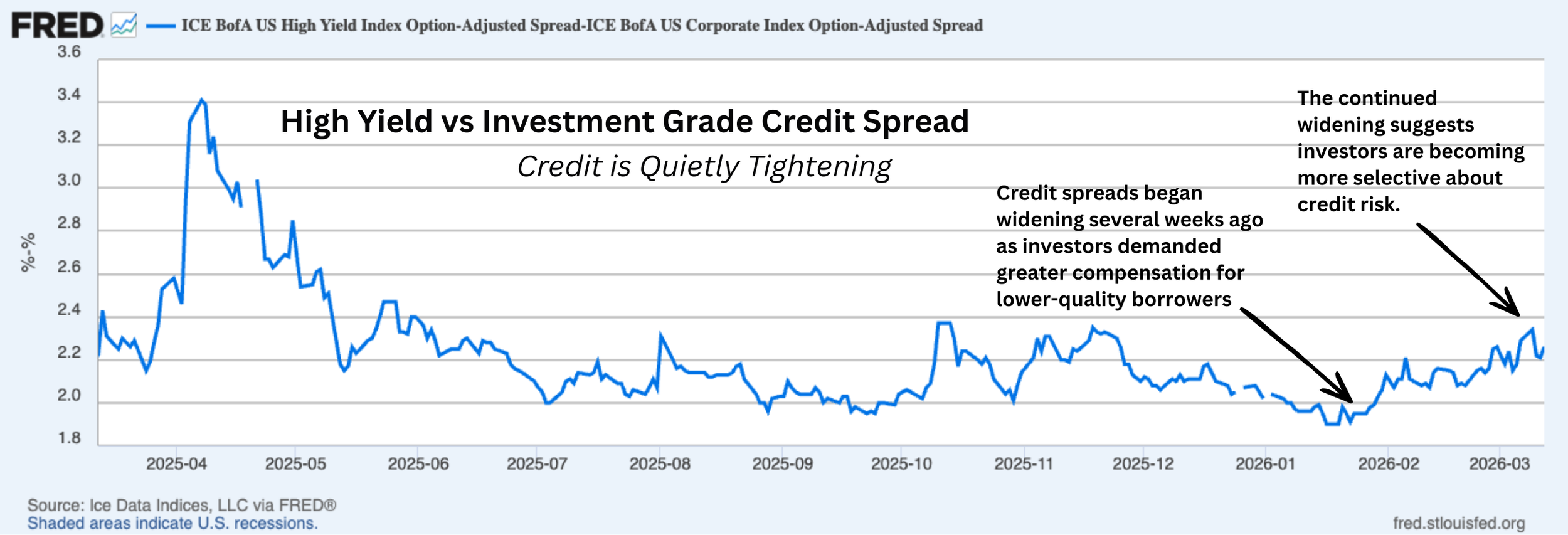
The move is not dramatic, but the consistency is notable.
When this gap increases, it typically means investors are becoming more selective about the credit risk they are willing to take.
In other words, capital is beginning to demand higher compensation for weaker balance sheets.
What this means in the real economy
Credit spreads are not just market statistics — they influence real corporate decisions.
When spreads widen:
Investors rotate toward safer bonds
Riskier borrowers face higher interest costs
New debt issuance becomes more expensive
For companies, this can translate into:
delayed capital investment
slower hiring plans
postponed expansion projects
This is one of the primary ways financial tightening eventually works its way from markets into the real economy.
A quick framework check-in
Several weeks ago we introduced a framework describing how financial stress tends to move through markets.
In simplified form, the sequence often looks something like this:
Volatility rises → risk appetite weakens → credit spreads widen → funding markets tighten
What we are currently observing is broadly consistent with the early credit-tightening stage of that sequence.
At this stage the shift is gradual, but it is a development worth watching closely.
Beneath the Surface: The Financial Plumbing
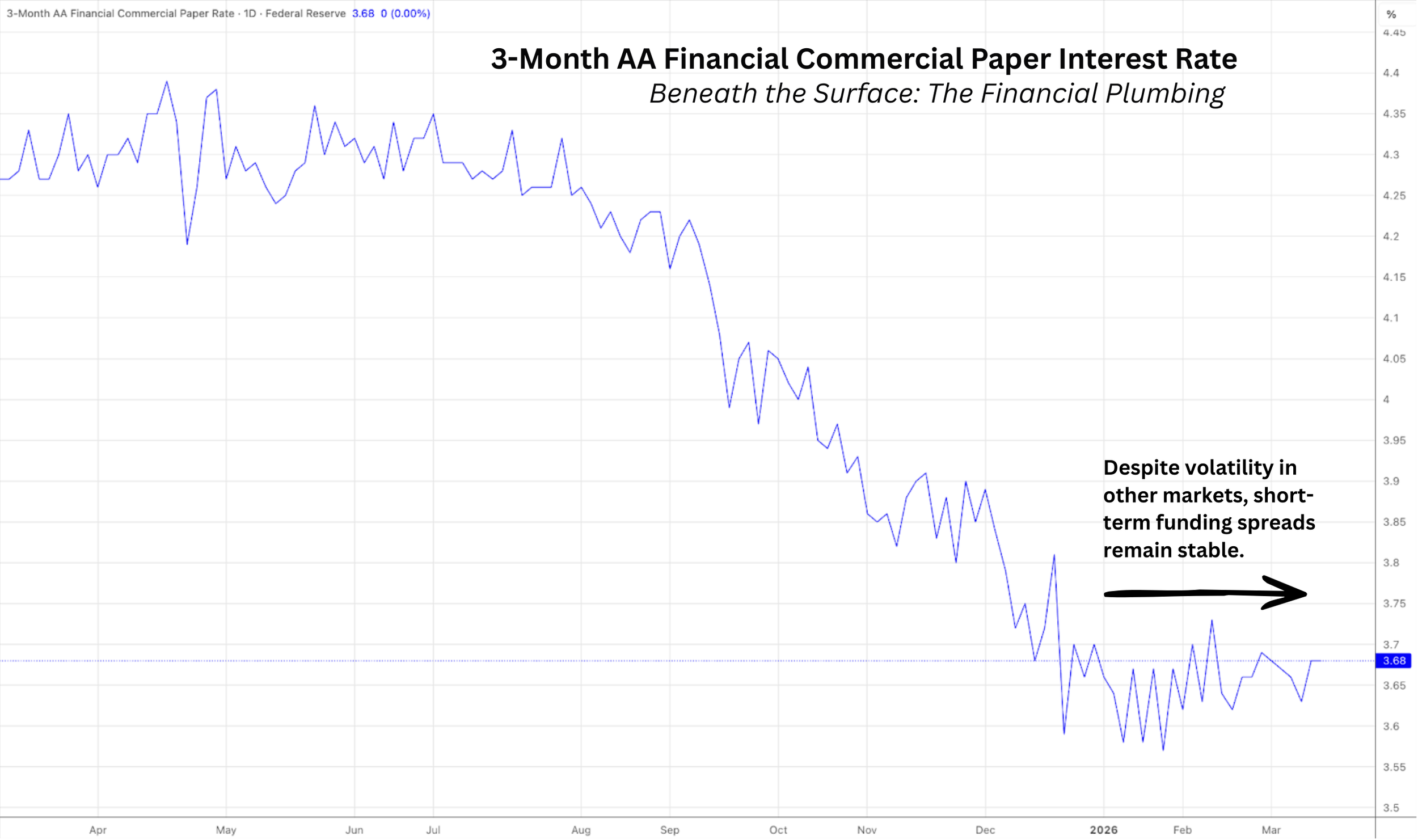
While credit markets are beginning to tighten, the core funding markets remain stable.
This distinction is important because credit markets and funding markets play very different roles in the financial system. Credit markets determine how expensive it is for companies to borrow. Funding markets determine whether financial institutions can obtain short-term liquidity to operate.
In other words:
Credit markets affect economic activity
Funding markets affect financial system stability
What the indicators show
Some of the indicators we monitor suggest that funding conditions remain calm.
Short-term funding rates are stable.
The spread between repo funding and Treasury bills remains minimal.
Commercial paper markets continue to function normally.
The Federal Reserve’s liquidity facilities remain largely unused.
Why This matters:
Historically, volatility becomes dangerous only when it begins to disrupt the plumbing of the financial system. That is when forced selling can emerge, leverage unwinds rapidly, and liquidity disappears.
At the moment, the fact that funding markets remain stable suggests something important. The financial system itself is still functioning normally, even as volatility and credit conditions evolve.
That distinction is one of the most important signals we track.
Liquidity Watch: The Treasury General Account
The final signal comes from a different layer of the system — fiscal liquidity.
The Treasury General Account (TGA) is essentially the U.S. government’s account at the Federal Reserve.
When the Treasury spends from this account, funds flow into the banking system, increasing overall liquidity.
Over the past six weeks the balance of the TGA has been on a light gradual decline.
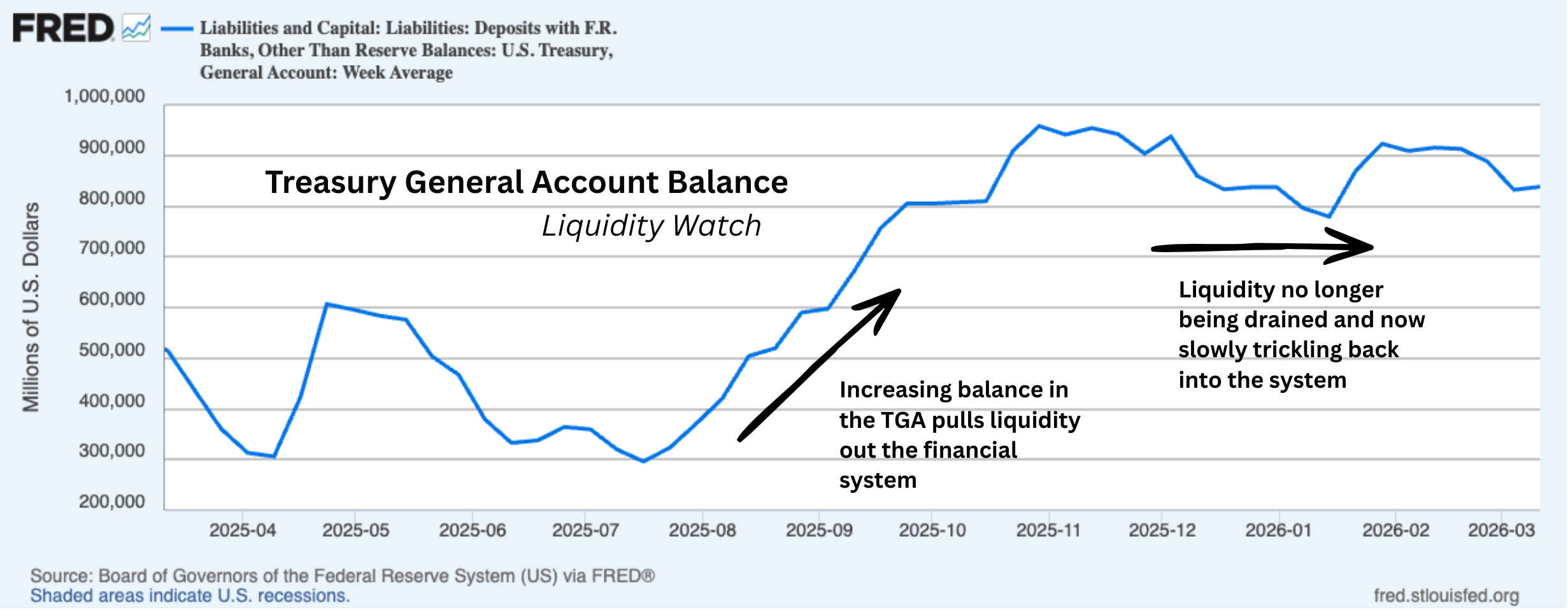
This slight decline suggests Treasury spending has been injecting liquidity into the financial system.
So far the magnitude of the drawdown has been light, and it has not meaningfully altered broader financial conditions.
However, if the drawdown were to accelerate, the resulting liquidity could begin to influence asset prices across multiple markets.
Where that liquidity ultimately flows — equities, commodities, credit markets, or digital assets — is difficult to predict.
For now, the signal simply reminds us that fiscal dynamics remain an important part of the liquidity environment.
What This Means for Investors
For investors, the current environment argues less for bold directional bets and more for careful risk management.
Three practical implications stand out.
First, volatility may remain elevated.
The combination of bond market uncertainty, geopolitical risk, and evolving fiscal conditions suggests that larger market swings could remain a feature of the environment for some time.
Second, credit markets deserve close attention.
Credit spreads often provide some of the earliest warnings of deeper financial tightening. If the widening trend accelerates meaningfully, it could signal broader pressure developing within the economy.
Third, liquidity still matters.
Even as markets adjust to higher volatility, structural liquidity flows — including Treasury spending and fiscal balances — continue to shape the overall financial landscape.
Understanding how volatility, credit conditions, and liquidity interact can help investors distinguish between temporary market turbulence and genuine systemic stress.
A Quick Note on Bitcoin
Bitcoin’s recent price behavior adds an interesting layer of ambiguity to the current market environment.
While several traditional indicators of risk appetite have weakened, Bitcoin has seen a modest rise over the past week. This move is not large enough to clearly signal resilience, nor sustained enough to indicate a structural shift in behavior.
Two interpretations remain possible:
Bitcoin may be attracting some capital as investors search for alternative macro assets during periods of uncertainty
Or the recent rise may simply represent a short-term countertrend move within a broader risk-off environment
At this stage the signal remains ambiguous.
But it is worth watching whether Bitcoin continues to move independently from traditional risk assets in the weeks ahead.
Look out for next week’s newsletter for further insight into the forces shaping today’s markets.